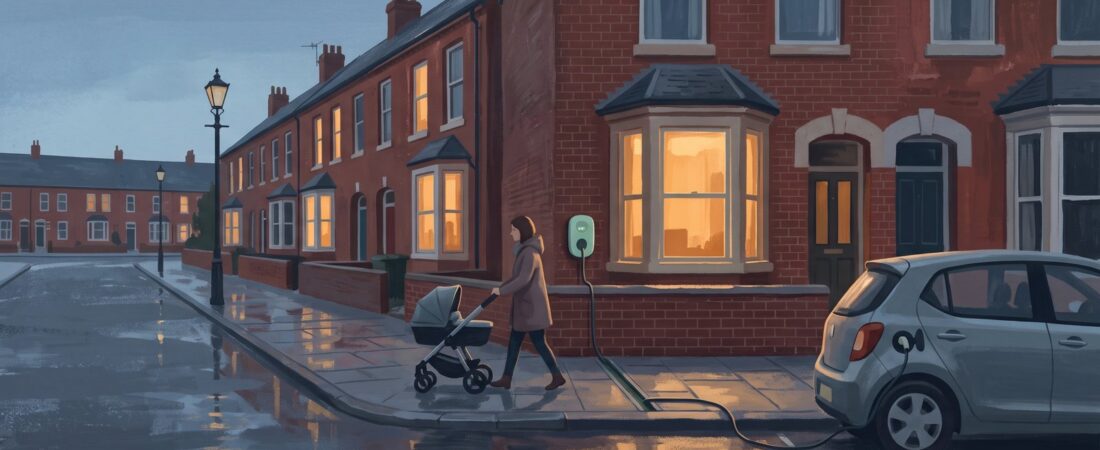
Yes, you can charge an electric car at home without a driveway. Since 21 October 2026, households in England no longer need planning permission for an approved cross-pavement cable channel, but your council must still agree to it. Where that isn’t possible, residential on-street chargers, workplace charging and cheaper public networks are the alternatives.
Key takeaways
- The planning hurdle has gone in England. From 21 October 2026, an approved cross-pavement channel is permitted development, except in conservation areas, within the grounds of listed buildings and at scheduled monuments.
- Your council is still the gatekeeper. The highway authority must install or authorise the channel, and some councils have no scheme yet.
- There is a grant. OZEV pays 75% of a home chargepoint, up to £500, when it is installed with a permanent cross-pavement solution. It closes on 31 March 2027.
- Never trail a cable over a mat. Cable covers and mats don’t qualify for the grant and can breach highways law.
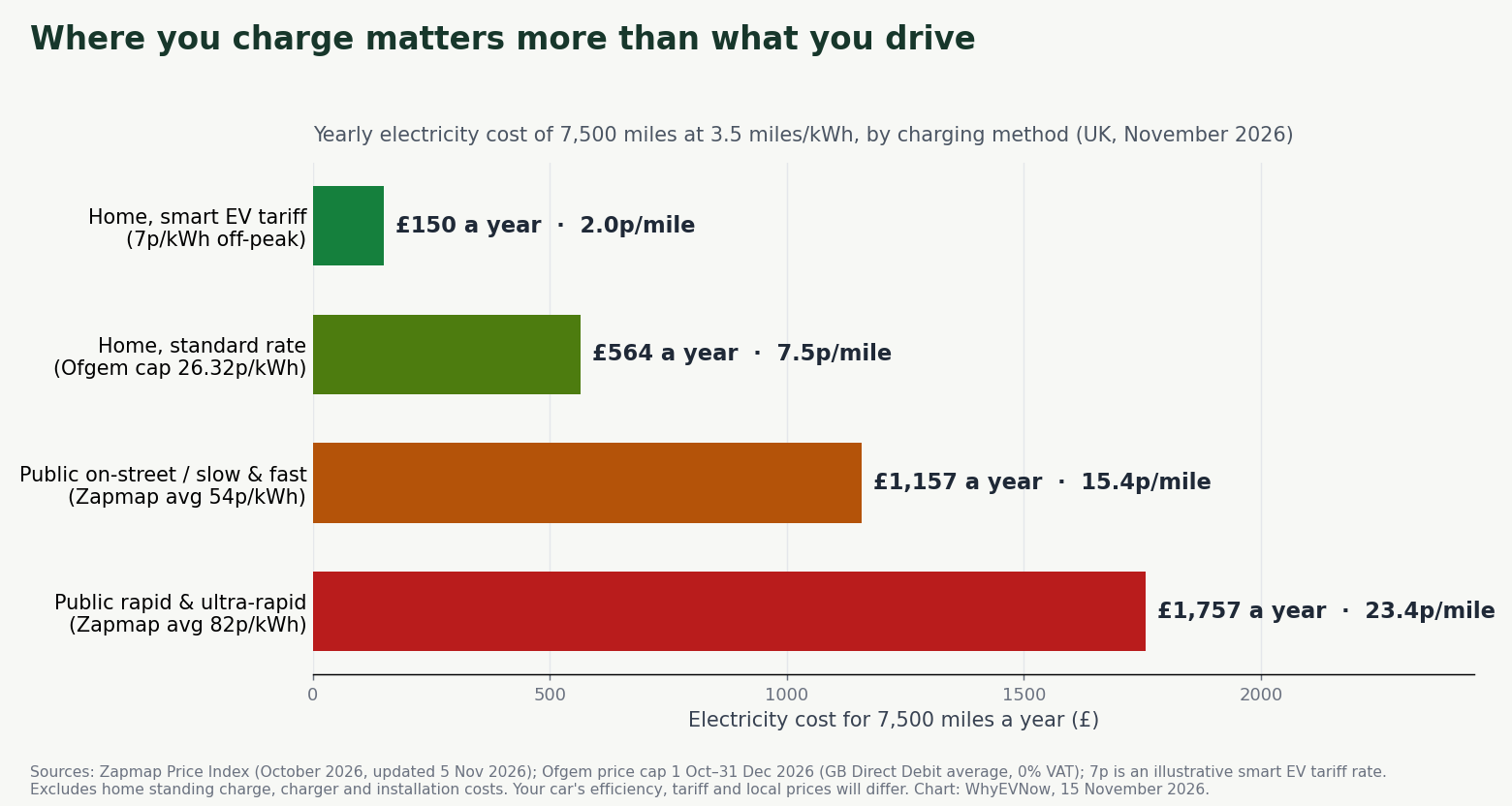
- The saving is large. At October 2026 prices, 7,500 miles costs about £150 on a 7p smart tariff, against about £1,157 on public slow chargers and £1,757 on rapid chargers.
Around a third of UK households have no driveway or off-street parking, according to HM Treasury’s Budget 2026 briefing. For them, the question of how to charge an electric car without a driveway decides whether an EV is cheap to run or merely as expensive as petrol. This guide covers the new cross-pavement rules, what they cost, the grant, and what to do if your council says no.
Can you charge an electric car at home without a driveway?
Yes, if you can usually park outside or near your home and your council allows a cross-pavement solution. The car stays on the street; the cable runs from a charger on your house wall through a channel in the pavement, so you pay your home electricity rate.
There are four realistic ways to charge if you live in a terrace, a flat or a house with no parking of its own:
- Cross-pavement charging from your own home supply. Cheapest per mile, but needs council approval.
- Residential on-street chargers, such as lamp-post or kerbside units installed by councils and operators.
- Workplace or destination charging, such as an office car park, supermarket or leisure centre.
- Rapid charging hubs, used for a quick top-up once or twice a week.
Most drivers without a driveway end up mixing two or three of these. Before you buy, look up the chargers within walking distance of home and work on the WhyEVNow UK charging map.
What changed for cross-pavement charging on 21 October 2026?
From 21 October 2026, England’s planning rules treat an approved cross-pavement cable channel as permitted development, so you don’t need a planning application. The Department for Transport says this saves up to £300 per installation.
The change was announced by the Department for Transport on 21 October 2026. It adds a new permitted development right for the channel and amends the existing rights for wall-mounted home chargers, so a charger can now be fitted on a house or block of flats that has no off-street parking. The key conditions:
- The highway authority must install, commission or authorise the channel. You can’t dig up the pavement yourself, and planning rules don’t force a council to say yes.
- Some places are excluded. The new right doesn’t apply in a conservation area, within the grounds (curtilage) of a listed building or at a scheduled monument. There you will need planning permission as well as the council’s consent.
- The pavement must stay usable. Under the updated GOV.UK cross-pavement guidance (updated 4 November 2026), a charger on a wall that directly adjoins the highway is not permitted development if it would leave less than 1.5 metres of footway between the charger and the road.
- It must be removed when no longer needed, with the pavement put back as it was.
This is an England-only planning change. Scotland, Wales and Northern Ireland have their own planning systems, so ask your local council what applies there. The chargepoint grant below is available across the UK.
How does cross-pavement charging work?
A cross-pavement solution is a permanent, approved way for a charging cable to cross the footway safely. The most common type is a narrow channel (often called a gully) set flush into the pavement, which holds the cable only while you charge.
GOV.UK’s guidance describes two main types. Embedded cable channels are the most widely trialled: you lift a lid or slot, lay your cable in, and remove it when charging finishes. The second type is a permanent cable under the pavement that ends in a kerbside connection point, such as a removable bollard or charging lance.
Three practical points catch people out:
- Mats and cable covers aren’t approved solutions. Running a loose cable over the pavement, even under a cover, can breach Part IX of the Highways Act 1980, and it doesn’t qualify for the grant.
- You don’t get a reserved space. The channel gives you no right to the parking bay outside your house, so it works best on streets where you can usually park nearby.
- Neighbours may not both qualify. GOV.UK’s installer specification says electrical equipment on different earthing systems needs to be at least 2.5 metres apart, which can rule out channels for two adjoining houses or near metal street furniture.
How do you get a cross-pavement charger installed?
Start with your council, not an installer. If the council has a scheme, you get a site check and highway consent, then apply for the grant, and only then have the charger and channel fitted.
- Check your council’s website. Search for “cross-pavement”, “EV cable channel” or “cable gully”. In two-tier areas, the county council is usually the highway authority. If there’s no scheme, the planning change doesn’t yet help you.
- Check your street. Councils look at pavement width, the parking outside, junctions, crossings, trees and other underground services. Double yellow lines usually rule a spot out.
- Get permission from others first. Renters need the landlord’s agreement for the wall charger; flat dwellers may need the freeholder’s. Private, unadopted roads need the landowner’s consent.
- Get a quote from an OZEV-approved installer for the chargepoint, using a grant-eligible charger model.
- Apply for the grant before any work starts. The grant can’t be backdated; you’ll need evidence of the highway authority’s consent.
- Have the channel and charger installed. The council or its contractor fits the channel; your installer fits the charger and claims the grant, which is taken off your invoice.
- Switch to a smart EV tariff. This is where the saving comes from. Compare options using the home charging guide on our Insights page.
How much does cross-pavement charging cost, and what grants are there?
You pay for two things: the pavement channel, which your council prices, and the home chargepoint, where the OZEV grant covers 75% up to £500. Some councils also charge an application fee or an ongoing licence.
| Item | Who sets the price | Support available (checked 15 November 2026) |
|---|---|---|
| Pavement channel or gully | Your council and its chosen supplier | Many councils subsidise channels through the government’s £25 million pavement channel fund for local authorities. Example: Surrey County Council charges residents £499 and says the full cost would normally be over £1,000. |
| Home chargepoint and installation | Your OZEV-approved installer | EV chargepoint grant for households with on-street parking: 75% of the cost, up to £500 (up from £350 on 1 April 2026). Requires a permanent cross-pavement solution and highway consent. Closes 31 March 2027. |
| Application fee, licence or maintenance | Your council | Varies. Some councils charge a one-off assessment fee, some an annual or multi-year licence, and some pass on maintenance once the warranty ends. Ask before you commit. |
Full grant terms are on the GOV.UK Find a Grant page for households with on-street parking. You must own or rent the home you live in, have no private off-street parking, and own, lease, have ordered, or be the main user of an eligible EV. You can’t claim it if you’re about to move house or have already had a home chargepoint grant.
Uptake has been tiny so far. By 1 April 2026 the on-street grant had funded just 48 sockets across the UK, according to OZEV’s grant statistics, which is a sign of how few councils were offering channels before the rules changed.
How much cheaper is home charging than public charging?
A lot. At November 2026 prices, a smart home tariff works out at about 2p a mile, against roughly 15p on public slow chargers and 23p on rapid chargers, for a car doing 3.5 miles per kWh.
| How you charge | Price per kWh | Cost per mile | 7,500 miles a year |
|---|---|---|---|
| Home, smart EV tariff (off-peak) | 7p (illustrative) | 2.0p | £150 |
| Home, standard variable tariff | 26.32p (Ofgem cap, GB average) | 7.5p | £564 |
| Public slow and fast (3–49kW) | 54p (Zapmap average) | 15.4p | £1,157 |
| Public rapid and ultra-rapid (50kW+) | 82p (Zapmap average) | 23.4p | £1,757 |
Zapmap’s Price Index, updated 5 November 2026, put October’s weighted average pay-as-you-go price at 54p/kWh for 3–49kW chargers and 82p/kWh for 50kW and above. Ofgem’s cap for 1 October to 31 December 2026 is 26.32p/kWh on average for Direct Debit customers, with no VAT on household electricity until 31 March 2027. Smart EV tariffs vary by supplier and region; Octopus Energy, for example, advertises Intelligent Octopus Go smart charging from 6.5p/kWh. We used 7p as a round illustrative rate.
What the gap means for payback: moving 7,500 miles from 54p public charging to a 7p home tariff saves about £1,000 a year. Even if your channel and charger cost £1,500 after the grant, that would be paid back in roughly 18 months. Run your own mileage through the EV cost-of-ownership calculator on the WhyEVNow Dashboard.
What if your council doesn’t allow cross-pavement charging?
Then charging an EV without a driveway still works, but it costs more. Choose the cheapest network near you, charge at slower on-street posts or at work, and watch for the government’s new support for local chargers from spring 2027.
- Pick the network, not just the charger. Zapmap’s October 2026 check of the ten biggest rapid networks found pay-as-you-go prices ranging from 51p to 93p/kWh. Tesla Superchargers open to all makes averaged 69p/kWh. Compare networks with the WhyEVNow charging network price comparison.
- Ask your council for an on-street charger. Councils are installing residential chargers with Local EV Infrastructure (LEVI) funding, and some let residents request one near their home.
- Use work and destination chargers. Free or cheap charging at work, or while you shop, can cover much of a typical week.
- Expect some help on local charging. At Budget 2026 on 28 October, the Treasury announced £100 million over two years from spring 2027 to cut prices at lower-powered residential public chargers, saving their users around £150 a year. It also set up a taskforce to explore letting drivers use their home tariff at some public chargers. Details haven’t been published yet.
Be aware that rapid prices are rising: Zapmap’s rapid average climbed from 77p in August to 82p in October 2026, and charge point operators warn that rising grid standing charges could push prices higher in 2027.
Is an electric car worth it if you can’t charge at home?
Sometimes. Zapmap’s analysis suggests drivers who rely entirely on public charging are often still better off than with a comparable petrol or diesel car, but the margin is far smaller and depends heavily on local prices.
An EV without home charging makes most sense if there’s a reasonably priced charger you will actually use within a short walk, or free charging at work, and your mileage is moderate. It makes less sense if your only option is a dear rapid hub, or if you do high motorway mileage on 85p-plus chargers. If you are still deciding, read our guide to buying your first electric car, and check how the brand you’re considering rates on the WhyEVNow Brand Longevity Score, our opinion-based rating of each brand’s staying power in the UK.
Frequently asked questions
Do I need planning permission for a cross-pavement EV charger?
Not in most of England since 21 October 2026, provided the channel is installed or authorised by the highway authority. You still need planning permission in a conservation area, within the grounds of a listed building or at a scheduled monument. Other UK nations have separate rules.
Can I run an EV charging cable across the pavement?
Only through a council-approved cross-pavement solution such as an embedded channel. Trailing a loose cable, even under a mat or cover, can breach the Highways Act 1980 and creates a trip hazard. Your council may treat it as an obstruction.
How much is the EV charger grant for on-street parking?
The OZEV grant pays 75% of the cost of buying and installing a home chargepoint, up to £500, when you also install a permanent cross-pavement solution. You need highway authority consent first, and the scheme closes on 31 March 2027.
Does a cross-pavement channel give me my own parking space?
No. It gives you no right to the space outside your home, and anyone can park there. It works best where you can park outside or very close to your home most days.
Can renters get cross-pavement charging?
Yes. Renters can apply for the on-street grant, but they need the landlord’s permission to fit the charger to the property, as well as the council’s consent for the channel. The government is consulting on making it harder for landlords to refuse.
How much does it cost to charge an EV without a driveway?
With public chargers only, Zapmap’s October 2026 averages of 54p/kWh (slow) and 82p/kWh (rapid) work out at roughly 15p and 23p a mile for a car doing 3.5 miles per kWh. A home smart tariff via a cross-pavement channel can cut that to about 2p a mile.
Sources and calculation method
Last checked: 15 November 2026. Department for Transport, cross-pavement planning announcement, 21 October 2026. DfT and OZEV, cross-pavement solutions guidance, updated 4 November 2026. OZEV, chargepoint grant for households with on-street parking and grant changes from 1 April 2026. HM Treasury, Cutting electric vehicle charging costs, 28 October 2026. Zapmap Price Index, updated 5 November 2026. Ofgem price cap, 1 October to 31 December 2026. Surrey County Council cable gully scheme, 17 June 2026.
Running costs use miles ÷ 3.5 miles per kWh × price per kWh, ignoring standing charges and charging losses. They are transparent scenarios, not personal quotations. Council schemes, fees, tariffs and grant rules change, so check the current position before you apply.