Chinese-brand electric cars can be a sensible buy in the UK in 2026, but check four things first: whether a possible import tariff could change the price before delivery, how long the warranty runs, how close the nearest authorised service centre is, and how strong the company behind the badge looks. No UK tariff on Chinese-made EVs had been announced as of 15 November 2026.
Key takeaways
- No tariff yet. The UK charges its standard 10% import duty on cars built in China. Ministers say no decision on extra tariffs has been taken.
- Chinese brands are mainstream now. They took 23.3% of UK new-car registrations in September 2026, across all fuel types.
- No government grant. None of BYD, MG, Jaecoo, Omoda, Leapmotor or Xpeng is on the GOV.UK Electric Car Grant list.
- Warranties vary widely. From 7 years (MG, Jaecoo) down to 4 years (Leapmotor) for the car; most cover the battery for 8 years.
- Brand strength varies too. On WhyEVNow’s Brand Longevity Score, BYD rates 65.3 and MG 59.6 out of 100; newer arrivals are not yet rated.
Why is everyone talking about Chinese electric cars?
Because Chinese brands have grown fast in Britain and the government is weighing whether to put tariffs on Chinese-made EVs, as the EU already has. Commentators expect a UK–EU summit on 20 November 2026 to bring the issue to a head.
The sales growth is striking. SMMT registration figures show Chinese brands sold 81,776 of the 350,536 new cars registered in September 2026, a 23.3% share, more than double their volume a year earlier (analysis by EV Compared). BYD was the UK’s second-biggest brand that month with 20,140 registrations, behind only Volkswagen. The Jaecoo 7 was the UK’s best-selling car in both September and October 2026.
Not all of these are electric. Much of the growth comes from plug-in hybrids: Chery says its Super Hybrid models made up 83% of its September volume, and BYD’s most popular UK model is the Seal U DM-i plug-in hybrid.
New arrivals keep coming. On 13 November, Xpeng announced five new UK models within 12 months and opened orders for its L03 coupe-SUV from £32,990.
Will the UK put tariffs on Chinese EVs?
Possibly, but nothing has been decided. As of 15 November 2026, the government says no tariffs have been imposed on Chinese EVs, and Business Secretary Jonathan Reynolds says any decision will be based on the UK’s own interests.
Here is where things stand:
- Today: the UK charges its standard 10% duty on cars built in China, whether electric or not.
- The EU’s approach: since 2024, the EU has added countervailing duties of 7.8% to 35.3% on China-built battery EVs, on top of its own 10% duty — up to 45.3% in total.
- Reports, not decisions: in October, The Times reported that ministers were ready to match the EU’s levy. Reuters said it could not verify the report.
- The pressure: the EU has linked British access to its “Made in Europe” programme to closer trade alignment, while China has warned it would respond to any restrictions. Reynolds and China’s commerce minister held a call on 11 November; neither side published details.
If the UK did follow the EU’s model, it would most likely apply to cars built in China, not to every Chinese-owned brand. The EU’s duties cover battery EVs only, which is why commentators expect any UK move to leave plug-in hybrids largely untouched. Where a car is built matters: Leapmotor, for example, began building the B10 at Stellantis’ plant in Spain in October 2026.
Should you buy now or wait?
There’s no need to rush or to wait purely because of tariff talk. If a car suits you at today’s price, the main risk is a price change between ordering and delivery, so check your order terms.
- Ask whether your price is fixed at order. Some contracts let the price change before delivery. Get the agreed on-the-road price in writing on the order form.
- Check where the exact car is built. Ask the dealer for the country of manufacture of your specific model and version.
- Don’t assume a tariff means higher prices. Manufacturers sometimes absorb duties to protect sales. It is genuinely uncertain.
- Cars already registered aren’t affected. A tariff applies to imports, so it wouldn’t change what you already own, though it could affect used values later. Nobody can reliably predict that.
This is general information, not financial advice. If you’re buying on finance, read the agreement before signing.
Do Chinese EVs get the Electric Car Grant?
No. When we checked the official GOV.UK list on 15 November 2026, none of BYD, MG, Jaecoo, Omoda, Leapmotor or Xpeng appeared among the cars eligible for the £3,750 or £1,500 Electric Car Grant.
The grant rewards cars built with lower-carbon manufacturing, and weighs the electricity grid where the battery and car are made. Some Chinese brands offer their own discounts instead; Leapmotor, for example, markets a “Leap-Grant”. These are manufacturer discounts, not government money, so compare the final on-the-road price rather than the label. Read more in our guide to buying your first EV.
How good are Chinese EV warranties?
Generally generous on the battery but varied on the rest of the car. Most of these brands cover the battery for 8 years, while vehicle cover ranges from 7 years (MG, Jaecoo) down to 4 years (Leapmotor).
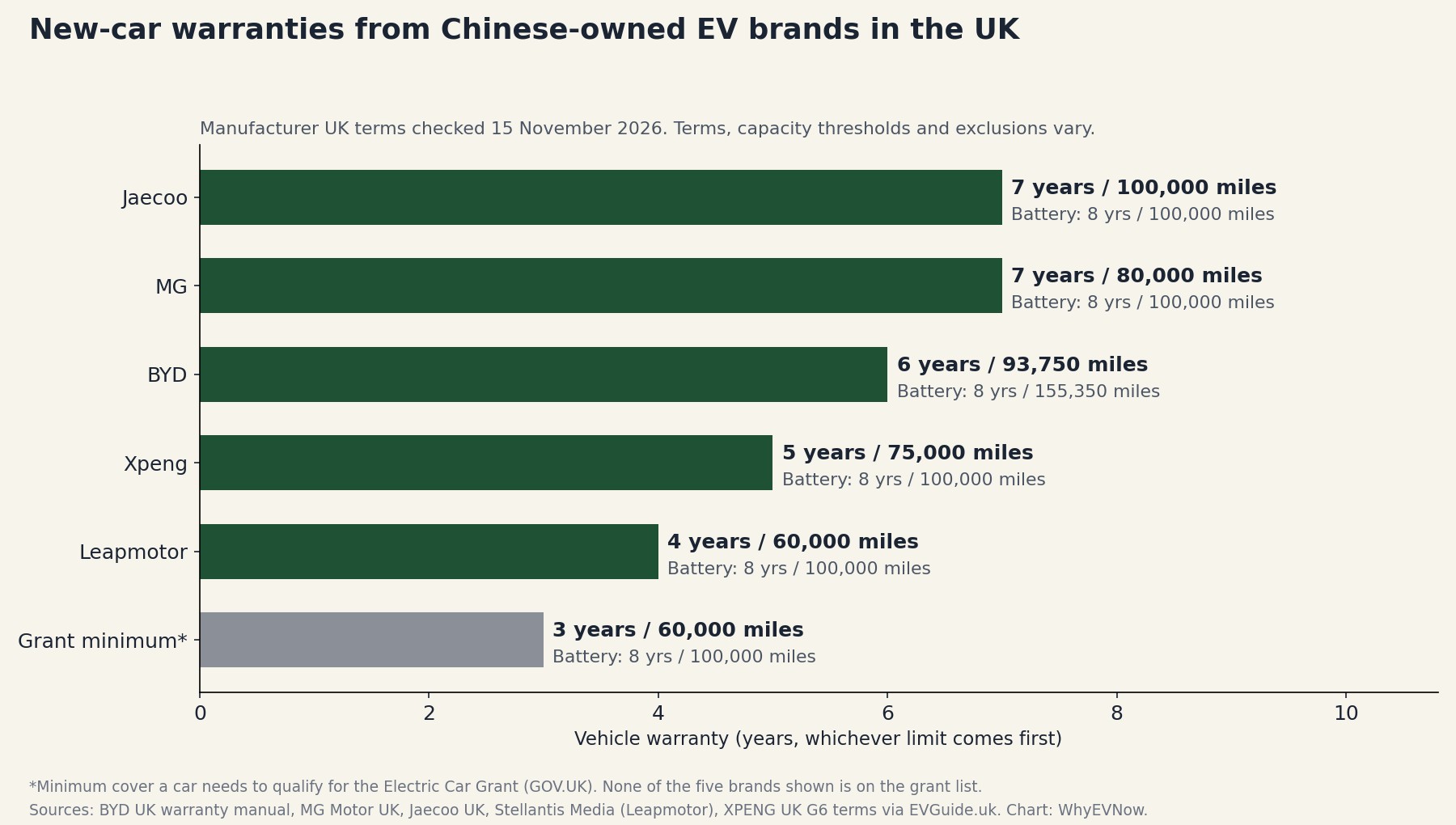
| Brand (owner) | Vehicle warranty | Battery warranty |
|---|---|---|
| Jaecoo (Chery) | 7 years / 100,000 miles | 8 years / 100,000 miles, to at least 70% capacity |
| MG (SAIC Motor) | 7 years / 80,000 miles | 8 years / 100,000 miles, below 70% capacity |
| BYD | 6 years / 93,750 miles | 8 years / 155,350 miles, at least 70% capacity |
| Xpeng | 5 years / 75,000 miles | 8 years / 100,000 miles |
| Leapmotor (Stellantis joint venture) | 4 years / 60,000 miles | 8 years / 100,000 miles |
Whichever limit comes first. Sources: Jaecoo UK, MG Motor UK warranty statement (July 2026), BYD limited warranty manual, Stellantis Media UK (Leapmotor), XPENG UK G6 terms as reported by EVGuide.uk. Checked 15 November 2026.
Two cautions. First, a warranty is only as useful as the network that honours it, so check where your nearest authorised repairer is and how long parts take. Second, warranty length isn’t evidence of reliability: several of these brands are too new in Britain for long-term UK data.
Which Chinese-owned EV brands look strongest long term?
On WhyEVNow’s Brand Longevity Score, BYD ranks first of the 18 brands we rate, at 65.3 out of 100, and MG scores 59.6. Two Geely-owned brands sit lower: Volvo at 51.2 and Polestar at 50, capped because of two risk flags.
| Brand | Parent company | Score | Grade | Data coverage |
|---|---|---|---|---|
| BYD | BYD Company | 65.3 | B | 75% |
| MG | SAIC Motor | 59.6 | C | 68% |
| Volvo | Geely Holding | 51.2 | C | 74% |
| Polestar | Geely Holding | 50.0 (capped) | C | 86% |
From the WhyEVNow Brand Longevity Score dashboard, updated 4 November 2026.
The score combines seven areas weighted with the Analytic Hierarchy Process: financial strength, sales momentum, warranty, resale value, reliability and owner feedback, technology, and UK presence. Note the data coverage: BYD’s score rests on 75% coverage and MG’s on 68%, so treat small differences cautiously. Jaecoo, Omoda, Leapmotor and Xpeng are not yet rated.
The Brand Longevity Score is WhyEVNow’s opinion based on public data. It isn’t financial advice or a prediction that any company will succeed or fail.
What should you check before buying a Chinese EV?
Check the dealer network, the exact warranty terms, insurance costs, charging performance and resale evidence for the specific model — the same checks as any EV, with extra weight on after-sales support for newer brands.
- Find your nearest authorised service centre. Some newer brands are still building their UK networks; Xpeng, for example, says it plans around 100 retail and service sites in 2027.
- Read the warranty booklet for your exact car. Check capacity thresholds, servicing conditions and whether cover transfers to the next owner.
- Get an insurance quote before ordering. Premiums for newer models can differ from established rivals.
- Look for independent resale data. For new arrivals, there may not be much yet, so budget cautiously.
- Check charging speeds and connector support. Compare the 10–80% charging time, not just peak kW, and find chargers near you on the WhyEVNow charging map.
- Confirm the fuel type. Many Chinese-brand bestsellers are plug-in hybrids, not pure EVs. Make sure you’re buying the one you want. If you can’t charge at home, see our guide to charging without a driveway.
Frequently asked questions
Is the UK putting tariffs on Chinese electric cars?
Not yet. As of 15 November 2026, the UK charges its standard 10% import duty on China-built cars, and the government says no tariffs have been imposed on Chinese EVs. Ministers are reviewing the issue, and a UK–EU summit on 20 November could bring news.
Will a tariff affect the Chinese EV I already own?
A tariff applies to new imports, so it would not change the car you already own. It could affect new-car prices and, indirectly, used values, but the effect cannot be reliably predicted.
Can I get the Electric Car Grant on a BYD or MG?
No. As of 15 November 2026, no BYD, MG, Jaecoo, Omoda, Leapmotor or Xpeng model is on the GOV.UK Electric Car Grant list. Some brands offer their own manufacturer discounts instead.
Which Chinese car brand has the longest warranty in the UK?
Jaecoo and MG offer 7-year vehicle warranties (100,000 and 80,000 miles respectively). BYD offers 6 years or 93,750 miles, with an 8-year, 155,350-mile battery warranty. Always check the terms for the exact car.
Are Chinese electric cars reliable?
It’s too early to say for many newer brands, because there isn’t much long-term UK data yet. Warranty length is not proof of reliability. Check owner surveys, the dealer network and independent reviews of the specific model.
Is MG a Chinese brand?
MG began as a British brand but is now owned by SAIC Motor, a Chinese state-owned car maker. Most of its UK models are built in China.
Sources
- GOV.UK: Zero emission vehicles eligible for a grant: cars, checked 15 November 2026
- SMMT new car registrations, September and October 2026 (via EV Compared, AM Online and Motoring Research)
- Reuters, 4 October 2026; The Guardian, 14 October and 12 November 2026; Automotive World, 20 October and 13 November 2026; CnEVPost, 12 November 2026
- Manufacturer warranty terms: Jaecoo UK, MG Motor UK, BYD, Stellantis Media UK (Leapmotor), XPENG UK via EVGuide.uk
- WhyEVNow Brand Longevity Score dashboard, updated 4 November 2026
Last checked: 15 November 2026. Tariff policy is changing quickly; we’ll update this article when the government announces a decision.