Not yet, and probably not everywhere. Rapid EV charging prices averaged 82p per kWh in October 2026, according to Zapmap. A report published on 11 November warns that £1 per kWh “could become commonplace” in 2027 because grid standing charges on rapid chargers keep rising. Nobody has announced a £1 price, and you can already pay far less than 82p by choosing how and when you charge.
Key takeaways
- Today’s average is 82p. Zapmap’s October 2026 Price Index puts rapid and ultra-rapid charging at 82p/kWh, up 3p in a month and about 8% in a year. Slower public chargers average 54p.
- £1 is a warning, not a price list. The Reverse the Charge report says electricity and grid charges alone will cost £1.03/kWh at a quiet rapid charger on 2027 tariffs. Busier sites spread that cost more thinly.
- The cause is a fixed grid charge. The report says one modelled rapid charger paid £61.47 a week in 2021, pays £440.13 a week in 2026 and will pay £541.73 a week in 2027, whether or not a car plugs in.
- How you pay matters more than the headline. The same 40kWh costs £36.80 on InstaVolt by contactless and £22.00 through its app overnight — 40% less.
- Home charging is unaffected. These charges apply to large business grid connections, not your home supply.
Will rapid EV charging really cost £1 per kWh in 2027?
It could at some chargers, but it is a modelled warning rather than a forecast for every network. The report behind the headlines calculates a cost of £1.03 per kWh, before VAT, at a lightly used rapid charger on 2027 grid tariffs. No charging network has announced a £1 price.
The report is called Reverse the Charge. It was published on 11 November 2026 by Tom Riley’s EV newsletter The Fast Charge, in partnership with the charging network Zest, and the story has been picked up by Auto Express (12 November) and Top Gear (16 November).
The key detail most headlines skip is the assumption. The £1.03 figure is for a standard rapid charger selling about 100kWh a day, which The Fast Charge describes as “about two or three visits”. It covers electricity and grid charges only — before rent, maintenance, payment fees, staff, VAT or any profit. A busy site selling several times that amount has a much lower cost per kWh.
It is also worth knowing who wrote it. Zest is a charging operator that would benefit from lower grid charges, so this is a campaign document. That doesn’t make the figures wrong — the government’s own review points the same way (see below) — but the tariff modelling is theirs and we have not been able to check it independently.
How much does rapid charging cost right now?
The UK average pay-as-you-go price for rapid and ultra-rapid charging (50kW and above) was 82p per kWh in October 2026, according to Zapmap’s Price Index updated on 5 November. Slower public chargers (3–49kW) averaged 54p per kWh.
Rapid prices were 79p in September and about 76p a year earlier, so the trend is upwards. The average hides a wide spread: Zapmap’s October check of the ten biggest rapid networks found standard prices from 51p (Tesla’s open Superchargers) to 93p, with InstaVolt the dearest network-wide at 92p.
| Where you charge | Price per kWh | Cost per mile* | 40kWh top-up |
|---|---|---|---|
| Rapid/ultra-rapid, UK average (Zapmap, Oct 2026) | 82p | 23.4p | £32.80 |
| Rapid at £1/kWh (report scenario) | £1.00 | 28.6p | £40.00 |
| Slower public chargers, UK average (Zapmap) | 54p | 15.4p | £21.60 |
| Home, Ofgem price cap (1 Oct–31 Dec 2026) | 26.32p | 7.5p | £10.53 |
| Home, smart EV tariff (Intelligent Octopus Go) | 6.5p | 1.9p | £2.60 |
| For comparison: petrol car, 45mpg, 168.45p/litre (RAC, 10 Nov) | — | 17.0p | — |
The honest takeaway from that last row: at today’s average, a driver who does all their miles on rapid chargers already pays more per mile than a 45mpg petrol car. Most EV drivers don’t charge that way — the savings come from charging at home or on cheaper slower chargers, and using rapids for journeys.
Why are grid standing charges pushing rapid charging prices up?
Since 2022, network companies have billed businesses a fixed daily charge based on the size of their grid connection rather than how much electricity they use. Rapid charging sites need big connections but often sit idle, so they pay for capacity they rarely use.
The change came from Ofgem’s Targeted Charging Review, decided in 2019 and introduced from 2022. For most businesses the effect was small. A rapid charger is different: it must be able to deliver high power the moment a car arrives, but across a day it may run at a fraction of that. Zest’s chief executive, Robin Heap, told Top Gear that charging hubs run at less than 10% of their peak across 24 hours.
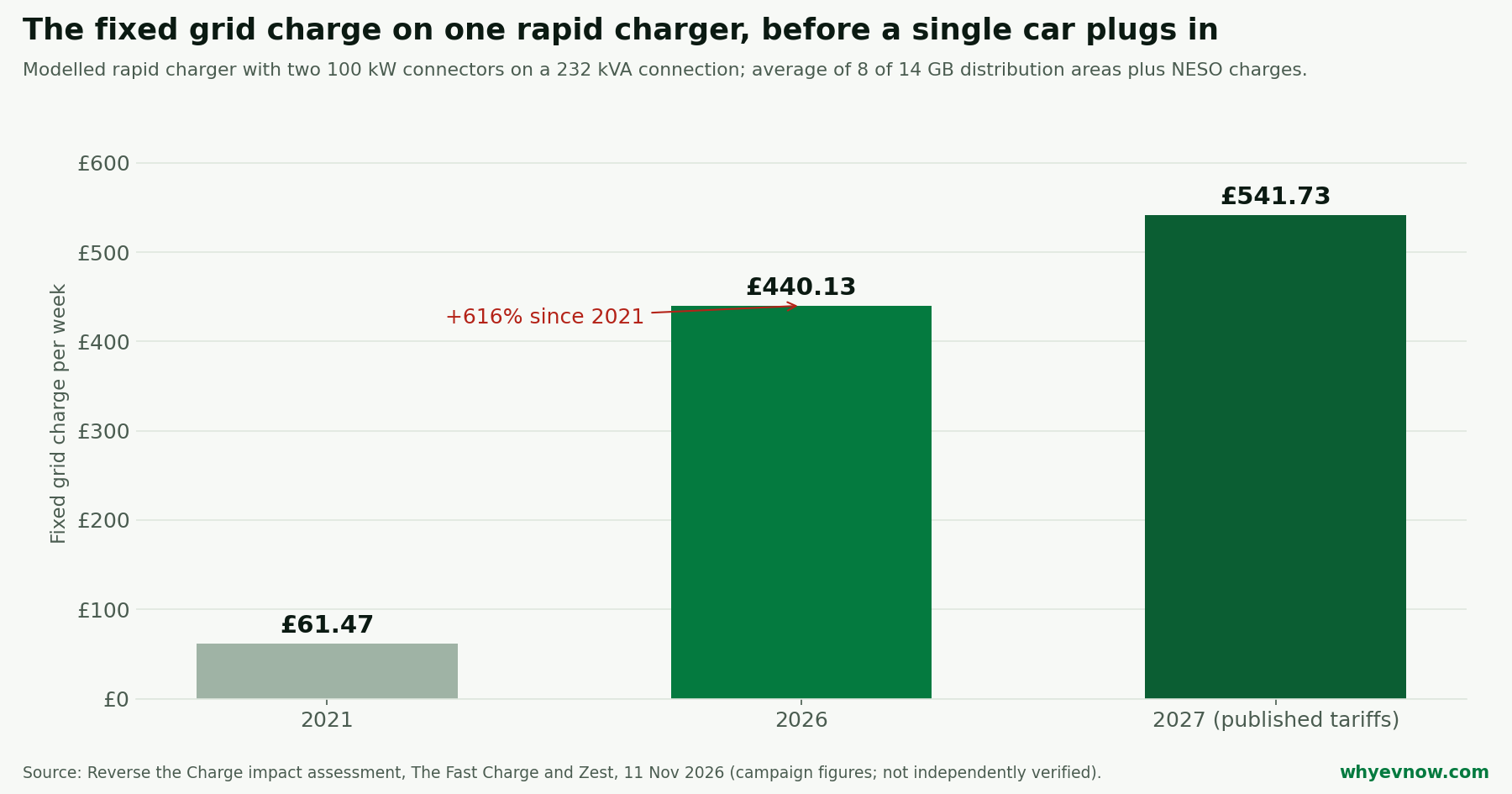
The report models a charger with two 100kW connectors on a 232kVA connection, averaging published tariffs from eight of Great Britain’s 14 distribution areas plus national transmission charges from the National Energy System Operator (NESO). Its key numbers:
- Fixed grid charge for one rapid charger: £61.47 a week in 2021, £440.13 in 2026 (+616%), and £77.39 a day (£541.73 a week) in 2027.
- Total paid by UK rapid-charging operators: about £336m in 2026, rising to about £413m in 2027, even if no new chargers are built.
- Two real Zest sites: at a Birmingham hub, electricity and grid costs take 48p of the 58p per kWh drivers pay before VAT; at an on-street ultra-rapid in London, 58p of 64p.
Why utilisation matters so much is easiest to see with simple division. Spreading the report’s 2027 fixed charge of £77.39 a day across the energy a charger sells gives this (WhyEVNow’s arithmetic):
| Energy sold per day | Fixed grid charge per kWh |
|---|---|
| 100kWh (the report’s assumption, about 2–3 cars) | about 77p |
| 200kWh | about 39p |
| 400kWh | about 19p |
| 800kWh | about 10p |
That is why quiet rural chargers and new sites are the most exposed, and why the networks increasingly focus on busy hubs.
What are the government and Ofgem doing about it?
Little on rapid chargers so far. The Budget on 28 October 2026 put £100m into cheaper local, lower-powered charging from spring 2027, but nothing into grid charges. Two industry rule changes that would cut them have not yet reached Ofgem for a decision.
- The independent review. The government’s Cost of Public Charging Review, led by Philip New and published with the Budget, found prices since 2021 had risen 69% at lower-powered chargers and 94% at higher-powered chargers in real terms (HM Treasury, 28 October 2026). According to The Fast Charge, it found the charging rules had a “severe impact” on operators’ costs and said Ofgem must “urgently address” them.
- £100m for local chargers. From spring 2027, £100m over two years will cut prices at lower-powered chargers near homes — about a third of the network — saving drivers who rely on them around £150 a year, the Treasury says. Rapid chargers are not included.
- Tariff porting. A taskforce will explore letting drivers use their home energy tariff at some public chargers. The Department for Transport has not yet published details.
- The proposed fixes. Rule changes known as DCP 420 (moving eligible sites to a lower charging band) and DCP 454 (returning them to a charge based on consumption) have sat in industry working groups for about three years. Ofgem told The Fast Charge it was open to evidence where its decision “is having unintended consequences”.
If you rely on on-street charging, our guide to charging an electric car without a driveway covers the £100m scheme, cross-pavement charging and grants in more detail.
How much would £1 per kWh add to your charging costs?
For a typical driver, less than the headline suggests. Moving from 82p to £1 per kWh adds about 5p a mile on rapid chargers, or £7.20 to a 40kWh top-up. If a fifth of your 7,500 annual miles are on rapids, that’s about £77 a year.
| Your rapid-charging habit (7,500 miles a year, 3.5 miles/kWh) | At 82p/kWh | At £1/kWh | Extra per year |
|---|---|---|---|
| Occasional journeys — 20% of miles (1,500 miles) | £351 | £429 | +£77 |
| Rapid-only, no home or slower charging (7,500 miles) | £1,757 | £2,143 | +£386 |
To run your own numbers, use the Charging Cost Planner on our EV Owners tools page.
How can you pay less for rapid charging now?
Pay through the network’s app, charge off-peak where networks offer it, and pick the network before you set off. The difference between the dearest and cheapest way to buy the same 40kWh is about £15 at the networks below.
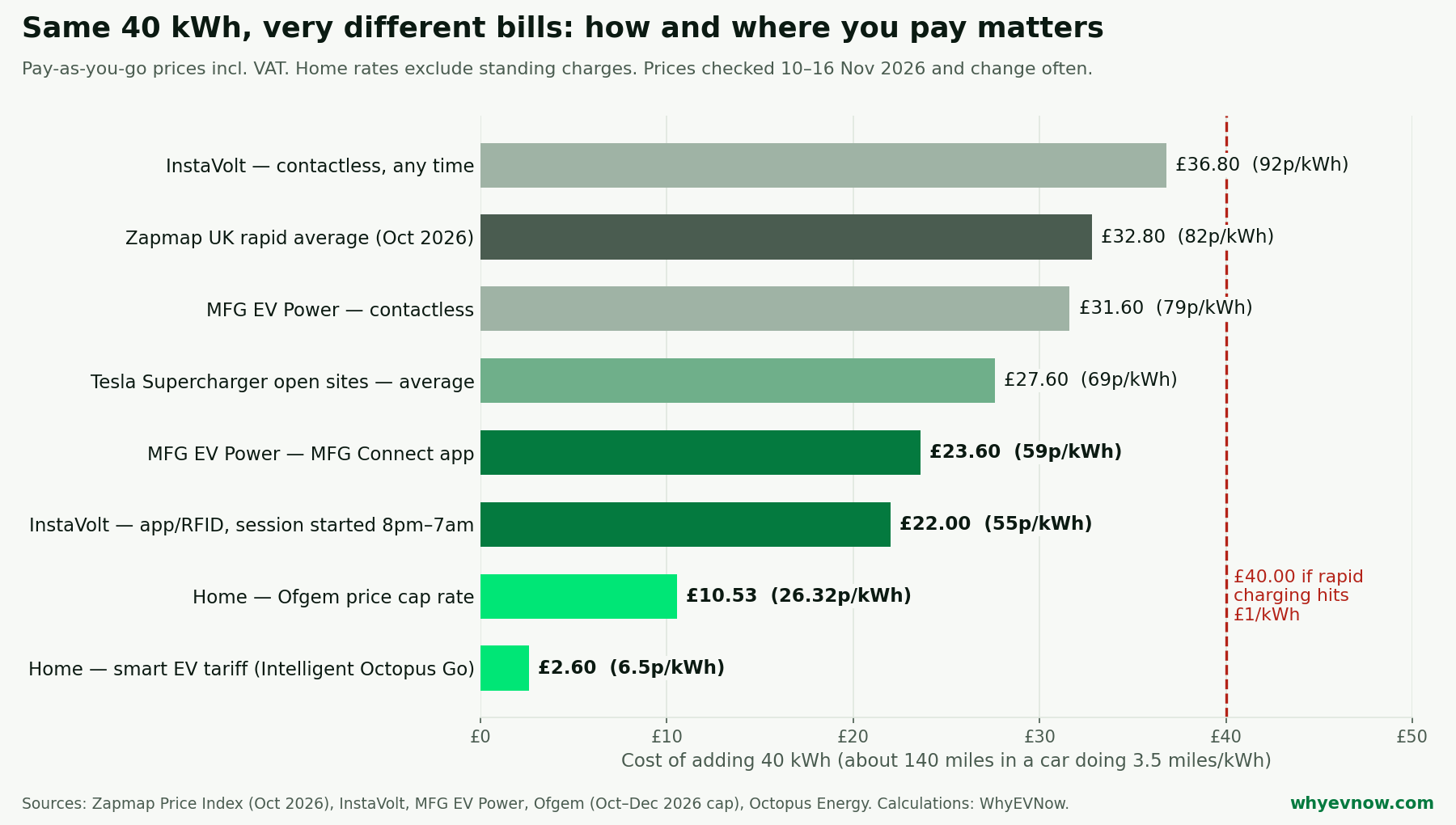
- Use the app, not your bank card. MFG EV Power charges 59p in its free MFG Connect app against 79p by contactless, a rate it made permanent from 1 October 2026. That’s £8 saved on a 40kWh charge.
- Charge in the evening where it’s cheaper. InstaVolt charges 92p at all times by contactless, but 55p for app or RFID-card sessions started between 8pm and 7am. Start at 7.55pm and you pay the full rate.
- Check Tesla’s open Superchargers. Zapmap puts the average at open sites at 69p for non-Tesla drivers, with prices set per site and dearer at busy times. You pay in the Tesla app.
- Consider a subscription only if you rapid-charge often. Several networks sell monthly plans that cut the per-kWh price; work out whether your monthly kWh covers the fee before signing up.
- Stop at 80%. Most cars charge much more slowly above about 80%, so you pay premium prices for slow kWh. Top up to what you need for the next leg.
- Use slower chargers when you’re parked anyway. At 54p on average, destination and on-street chargers cost about a third less than rapids.
Prices change often and can vary by site. Before a long trip, compare networks in the network price comparison on our UK Charging Map, which lists contactless, app, off-peak and subscription prices side by side, then confirm the price on the charger or in the app.
Should rising rapid charging prices put you off an EV?
Not if you can charge at home or on cheaper local chargers. It’s a real concern if you’d rely mainly on rapid chargers: at 82p you already pay more per mile than an efficient petrol car, and £1 would widen that gap.
With a driveway and a smart tariff, rapid prices barely matter: at 6.5p per kWh, home charging costs about 1.9p a mile. Without a driveway, look at the slower chargers near you, workplace charging and cross-pavement options before deciding. If rapid chargers would be your only option, a petrol hybrid may honestly be cheaper to run for now. Our first EV buying guide walks through that decision.
Latest UK EV news
- 16 November — Climate advisers to weigh in on EV targets. The Climate Change Committee will write to ministers on Wednesday 18 November on how changing the zero emission vehicle (ZEV) mandate would affect the cost of living and net zero. The mandate currently requires 80% of new car sales to be electric from 2030; no decision on changing it has been announced. (Source: The Guardian, 16 November 2026)
- 13 November — Tesla named best rapid network for a third year. Zapmap’s 2026/27 network awards, based on 5,346 driver responses, again ranked Tesla’s open Superchargers top among large rapid networks. Arnold Clark Charge won the medium-network category and Connected Kerb the destination and on-street category. (Source: Electric Cars Report on the Zapmap awards, 13 November 2026)
- 12 November — More cars get the full £3,750 grant. The facelifted Hyundai Ioniq 6 has joined Band 1 of the Electric Car Grant, and the Renault Megane and Scenic have moved up to Band 1. The Skoda Epiq is now listed in Band 2 (£1,500). (Sources: GOV.UK eligible cars list, checked 16 November 2026; Carwow, 12 November 2026)
Frequently asked questions
Will rapid charging cost £1 per kWh in 2027?
No network has announced it. The Reverse the Charge report says £1 per kWh could become common in 2027, based on a modelled cost of £1.03 per kWh at a rapid charger selling about 100kWh a day. Busier chargers have lower costs per kWh. Zapmap’s October 2026 average was 82p.
Why is rapid charging so expensive in the UK?
Operators pay for electricity, equipment, land and 20% VAT, plus a fixed grid charge based on connection size. The Reverse the Charge report says that fixed charge for one rapid charger rose from £61.47 a week in 2021 to £440.13 in 2026, and many sites are still lightly used.
What is the cheapest rapid charging network in the UK?
In Zapmap’s October 2026 check of the ten biggest rapid networks, Tesla’s open Superchargers were cheapest, from 51p per kWh. App and off-peak deals can beat that elsewhere, such as InstaVolt’s 55p for app sessions started between 8pm and 7am.
Will rising grid charges affect home charging?
No. The charges in the report apply to businesses with large grid connections, such as charging hubs. Home charging is set by your domestic tariff: the Ofgem price cap is 26.32p per kWh until 31 December 2026, and smart EV tariffs start from about 6.5p.
Is the £100m charging fund for rapid chargers?
No. The £100m announced in Budget 2026 runs over two years from spring 2027 and cuts prices at local, lower-powered chargers near homes. The Treasury says that could save drivers who rely on them around £150 a year.
Is rapid charging cheaper than petrol?
Not always. At 82p per kWh, an EV doing 3.5 miles per kWh costs about 23.4p a mile on rapid chargers, against about 17p a mile for a 45mpg petrol car at 168.45p a litre. EVs save money when most charging is at home or on slower chargers.
Sources and calculation method
- Zapmap Price Index, October 2026 (updated 5 November 2026), and Zapmap top 10 rapid network prices (updated 30 October 2026)
- Reverse the Charge impact assessment and Zest press release, 11 November 2026; The Fast Charge, 11 November 2026; Top Gear, 16 November 2026
- HM Treasury, Cutting electric vehicle charging costs, 28 October 2026
- Ofgem energy price cap, 1 October–31 December 2026
- Operator prices: InstaVolt pricing terms (via EV Compared, checked 10 November 2026); MFG EV Power, 1 October 2026; Octopus Energy Intelligent Octopus Go
- RAC Fuel Watch petrol average, 10 November 2026 (via PetrolPrices.co.uk)
- Method: cost per mile = price per kWh ÷ 3.5 miles per kWh. Petrol cost per mile = price per litre × 4.546 ÷ mpg. Electricity only; excludes standing charges, parking, subscriptions and charging losses.
Last checked: 16 November 2026. Charging prices change often; we’ll update this article if Ofgem acts on grid charges or networks change their prices.