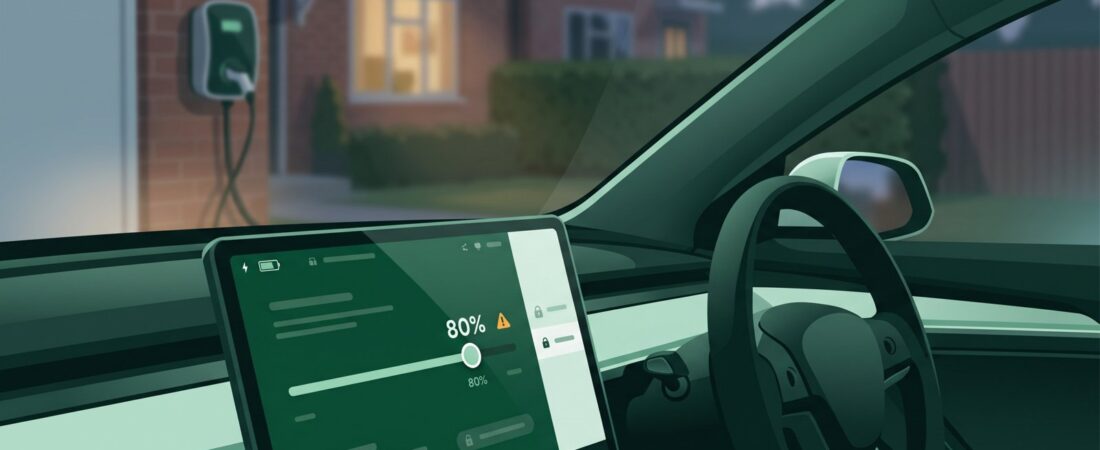
Some Volkswagen ID.3, ID.4, ID.7, ID. Buzz and CUPRA Born electric cars are being recalled because their high-voltage battery may overheat if charged above 80%. Until a dealer checks the battery, affected cars are capped at 80% charge, usually remotely. You can still drive and rapid charge. The check takes about an hour and is free.
Key takeaways
- Three UK recalls, 5,862 cars. DVSA notices dated 14 October 2026 cover campaigns 93MF (4,173 vehicles), 93MV (1,194) and the CUPRA Born’s 93W4 (495).
- The fault: battery components from one unnamed supplier may not meet Volkswagen’s standards and can overheat above 80% charge, posing a fire risk.
- What you lose: about a fifth of your range, roughly 53 to 87 miles on official WLTP figures, until the car is checked.
- What you keep: the car can be driven normally, rapid charging still works, and the work is free.
- What to do today: check your registration on GOV.UK, make sure the 80% limit is on, and wait for the letter to book an appointment.
What is the VW battery recall, and why is the charge capped at 80%?
Volkswagen says that in some cars, components inside the high-voltage battery “might not meet our high-quality standards”. When those batteries are charged above 80%, overheating may occur and could start a fire. Capping charge at 80% lowers the load on the battery and keeps a safety margin until each car has been checked.
The details come from Volkswagen UK’s own 93MV and 93MF recall page, the matching Volkswagen Commercial Vehicles page for the ID. Buzz, and CUPRA UK’s 93W4 page for the Born. All three say the batteries came from “a specific supplier between 2022 and 2025”. Volkswagen won’t name the supplier.
Volkswagen says there are no confirmed cases of injury but there have been “individual cases with property damage”. That puts the risk in perspective: it is rare, but it is a real fire risk, and the 80% limit is a safety instruction rather than a suggestion.
Which cars are affected in the UK?
Three DVSA safety recalls, all dated 14 October 2026, cover selected Volkswagen ID.3, ID.4, ID.7, ID. Buzz and ID. Buzz Cargo vehicles and the CUPRA Born. Only cars with batteries from the affected supplier are included, so a build date inside the ranges below is a first clue, not proof.
| Campaign (DVSA ref) | Models | Build dates in the DVSA notice | UK vehicles |
|---|---|---|---|
| 93MF (R/2026/397) | VW ID.3 | 12 Sep 2022 – 15 May 2024 | 4,173 in total |
| VW ID.4 | 21 Nov 2022 – 29 Oct 2024 | ||
| VW ID.7 | 6 Dec 2023 – 27 Mar 2025 | ||
| VW ID. Buzz | 5 Sep 2022 – 20 Jun 2024 | ||
| VW ID. Buzz Cargo | 21 Sep 2022 – 23 Aug 2023 | ||
| 93MV (R/2026/398) | VW ID.4 | 15 Jan 2024 – 17 Sep 2024 | 1,194 in total |
| VW ID.7 | 18 Sep 2023 – 27 Jun 2025 | ||
| 93W4 (R/2026/396) | CUPRA Born | 12 Sep 2022 – 16 May 2024 | 495 |
That is a small share of the Volkswagen Group EVs on UK roads. Autocar reported on 6 November that the UK notice covers around 5,000 cars out of about 85,000 worldwide; the DVSA notices add up to 5,862.
What about the Audi Q4 e-tron and Skoda?
Audi has recalled Q4 e-tron and Q4 Sportback e-tron models in other markets for the same kind of fault (Audi campaign 93SK), but Autocar reported that the UK notice does not list the Q4. Electrive reported that Skoda models are not affected. If you drive any MEB-based car (Audi Q4, Skoda Enyaq or Elroq, VW ID.5), a 30-second check of your registration on GOV.UK is still worth doing, because recall lists can be updated.
How do I check if my car is affected?
The quickest way is the GOV.UK vehicle recall checker: enter your registration and it shows any open recalls. You can also give your 17-digit VIN to an authorised Volkswagen or CUPRA retailer. Volkswagen will write to the registered keeper of every affected car.
- Check GOV.UK. Enter your registration. It only takes a few seconds.
- Check the car. In the app or on the screen, try to set the charge limit above 80%. Volkswagen says that if the cap has been applied, “the slider will not stay above 80% but automatically slips back”.
- If the slider goes above 80%, the remote cap hasn’t reached your car. Volkswagen says the car must be online, with privacy settings set to off, and the ignition on for at least five minutes for the update to arrive.
- Make sure the DVLA has your current address. Recall letters go to the address on your V5C logbook. Fleet and lease drivers should check with their leasing company, which Volkswagen says it has contacted.
- Keep the letter and the stickers. DVSA’s notices say the letter includes warning stickers for the dashboard and the charging socket, which must be put on the car.
How do I turn on Battery Care Mode myself?
If your car is affected and the remote cap isn’t in place, Volkswagen says you must set the 80% limit yourself using Battery Care Mode. It takes under a minute in the app or on the infotainment screen.
In the Volkswagen app: log in, select Battery and Charge, then Battery management, tap the settings (gear) icon at the top right and activate Battery Care Mode.
On the car’s screen: select Charging from the main menu, then Settings, then activate Battery Care Mode. CUPRA UK gives the same steps for the Born.
Volkswagen also says it is “good practice in all cases” to use Battery Care Mode for everyday charging, so owners of cars outside the recall lose nothing by switching it on.
Can I still drive and rapid charge my car?
Yes. Volkswagen says affected cars “can continue to be used” and that DC rapid charging is still possible, because the cap limits how full the battery gets, not which charger you use. If a yellow warning lamp appears, contact a Volkswagen or CUPRA retailer promptly.
In practice, the cap matters less than it sounds for rapid charging. Many drivers already stop rapid charging at around 80%, because charging usually slows sharply after that. Where you will notice it is on longer trips that start from home, when you’d normally leave with a full battery.
Volkswagen’s emergency advice, if the worst happens, is to stop, park outdoors if possible, switch off, get everyone out and call the emergency services.
How much range will I lose with the 80% cap?
About a fifth of your range. On official WLTP figures, that is roughly 53 miles on a 58kWh ID.3 or CUPRA Born and up to 87 miles on an ID.7 Pro S with the 86kWh battery. Real-world losses are smaller in miles because real-world range is lower, especially in winter.
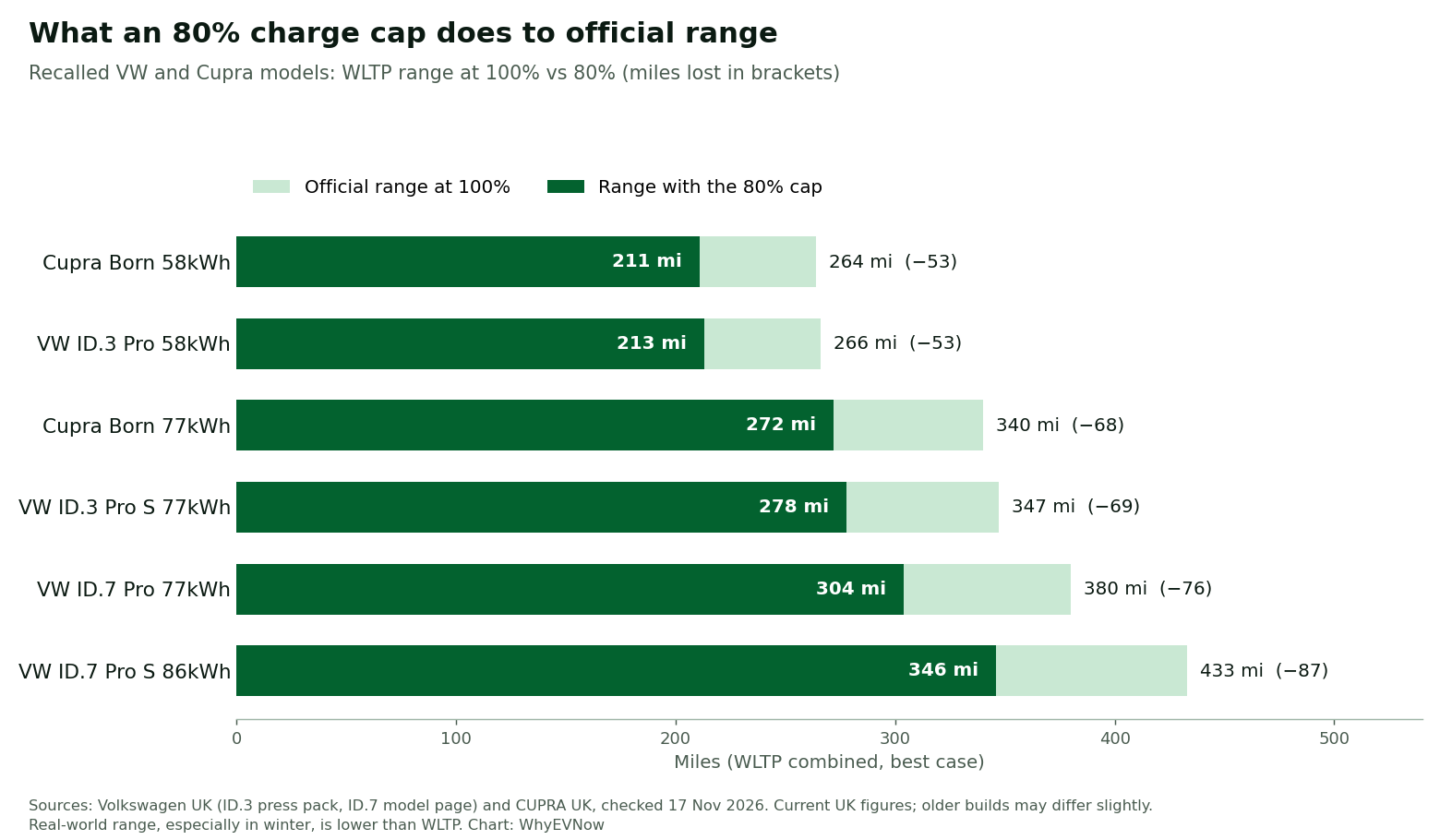
These match the range of estimates in the motoring press: Parkers puts the loss at about 50 miles for the lowest-range ID.3 and almost 90 miles for the ID.7 Pro S. For a daily commute of 20 to 40 miles, the cap is unlikely to change anything. For a 250-mile motorway trip, plan one more rapid stop than usual; the WhyEVNow UK Charging Map shows rapid chargers along your route.
The cap doesn’t change what you pay per mile, but more public charging stops could. Our guide to rapid charging prices and how to pay less shows the same 40kWh can cost £36.80 or £22.00 depending on how you pay.
What happens at the dealer, and does it cost anything?
Nothing. Volkswagen says all work is free. You will be asked to book an appointment at an authorised retailer, where the battery check takes about an hour. If problems are found, battery modules are replaced. Once all work is done, full charging capacity, and so full range, is restored.
According to the 93MV DVSA notice, the retailer creates a diagnostic log of the battery’s condition and uploads it to Volkswagen. If the data looks normal, the 80% restriction is lifted. If irregularities are found, the cap stays until the affected battery modules are replaced. Volkswagen says some cars may instead get a software-based fix, and that owners will be told separately about the date and process for the software update.
You can’t book yet in most cases: Volkswagen says it will write when appointments can be scheduled, and that diagnosis capacity and replacement parts need to be lined up first. It has not published a timetable.
Safety recall work is separate from the battery warranty, so it applies whatever the car’s age or how many owners it has had. For warranty cover itself (Volkswagen’s battery warranty is typically 8 years or 100,000 miles), use our Battery & Warranty Checker to see how much time and mileage your car has left. If a dealer won’t carry out recall work, the DVSA can be contacted.
Should this put you off buying a Volkswagen ID or CUPRA Born?
Not on its own. The recall affects a small share of cars, has no confirmed injuries, and is being fixed free of charge. But if you’re buying a used ID.3, ID.4, ID.7, ID. Buzz or Born built between 2022 and 2025, check the recall status before you pay.
- Run the registration through the GOV.UK recall checker and ask the seller whether a recall letter has arrived.
- Ask whether the battery check has been done. If it hasn’t, the car will be capped at 80% on your test drive, so judge the range with that in mind.
- Buying from a dealer? Ask for the recall work to be completed, or confirmed booked, before you collect.
WhyEVNow’s Brand Longevity Score currently rates Volkswagen 57.1 out of 100 (grade C, 11th of 18 brands). Its strongest areas are UK presence and sales; reliability and owner feedback, at 36.3, is its weakest. CUPRA isn’t scored separately. The score is our opinion based on public data, not a prediction or financial advice. For broader used-EV checks, see our first-EV buying guide.
Latest UK EV news
- 16 November — Volkswagen ID. Cross orders open on 19 November. The compact electric SUV starts at £30,260 for the 52kWh Life (265 miles WLTP) and £33,675 for the Style; both qualify for the £1,500 Electric Car Grant. A 37kWh version from £26,985 follows in January, with its grant eligibility not yet confirmed. (Source: AM Online, 16 November 2026)
- 13 November — How dealers will handle pay-per-mile EV tax. After a meeting with the DVLA, the National Franchised Dealers Association says that when Electric Vehicle Excise Duty (eVED) starts, dealers will estimate a new car’s first-year mileage with the buyer and collect the charge with vehicle tax. GOV.UK confirms eVED starts on 1 April 2028 at 3p a mile for battery EVs and 1.5p for plug-in hybrids. (Sources: NFDA, 13 November 2026; GOV.UK, 5 November 2026)
- 16 November — Energy price cap expected to rise in January. EDF forecasts Ofgem’s cap could rise to £2,172 a year for a typical dual-fuel home from 1 January; Ofgem will confirm the figure later this month. Home EV charging on a standard variable tariff would cost more, while fixed and smart EV tariffs aren’t covered by the cap. (Source: EDF, 16 November 2026, a supplier forecast)
Frequently asked questions
Which cars are in the VW battery recall in the UK?
Selected Volkswagen ID.3, ID.4, ID.7, ID. Buzz and ID. Buzz Cargo models, and the CUPRA Born, with high-voltage batteries from one supplier built between 2022 and 2025. DVSA’s three notices of 14 October 2026 (R/2026/396, 397 and 398) list 5,862 vehicles. Not every car built in those years is included.
Can I still drive and rapid charge my car while it is capped at 80%?
Yes. Volkswagen says affected cars can still be used and DC rapid charging still works. The only restriction is that the battery must not be charged above 80% until the check is done. Contact a retailer promptly if a yellow warning lamp appears.
How do I check if my car is affected?
Enter your registration on the GOV.UK vehicle recall checker, or give your 17-digit VIN to an authorised Volkswagen or CUPRA retailer. In the car, try setting the charge limit above 80%: if the slider springs back, the remote cap has been applied.
Does the recall cost anything or affect my warranty?
No. Volkswagen says all recall work is free, including battery module replacement if needed. Safety recall work is separate from the warranty, so it applies whatever the car’s age or how many owners it has had.
Is the Audi Q4 e-tron included in the UK recall?
Audi has recalled Q4 e-tron models abroad under campaign 93SK, but Autocar reported on 6 November 2026 that the UK notice did not list the Q4. Q4 owners should still check their registration on GOV.UK, as recall lists can be updated.
Should I avoid buying a used VW ID.3, ID.4 or ID.7?
Not necessarily. Check the registration on GOV.UK before you buy, ask whether the recall letter has arrived and whether the check has been done, and test-drive with the 80% cap in mind. The recall work is free for whoever owns the car.
Sources
- Volkswagen UK, 93MV and 93MF high voltage battery safety recall and Volkswagen Commercial Vehicles UK, 93MF recall (checked 17 November 2026)
- CUPRA UK, 93W4 high voltage battery safety recall (checked 17 November 2026)
- DVSA vehicle recall notices R/2026/396, R/2026/397 and R/2026/398, 14 October 2026; GOV.UK vehicle recall checker
- Autocar, 6 November 2026; Parkers, 9 November 2026; electrive, 21 October 2026
- WLTP ranges: Volkswagen UK ID.3 press pack (58kWh 266 miles, 77kWh 347 miles), Volkswagen UK ID.7 page (77kWh 380 miles, up to 433 miles), CUPRA UK (58kWh up to 264 miles, 77kWh up to 340 miles). Range at 80% = official range × 0.8.
- WhyEVNow Brand Longevity Score, as displayed on 17 November 2026
Last checked: 17 November 2026. Recall details can change; we’ll update this article when Volkswagen publishes its appointment timetable or the UK recall list changes.